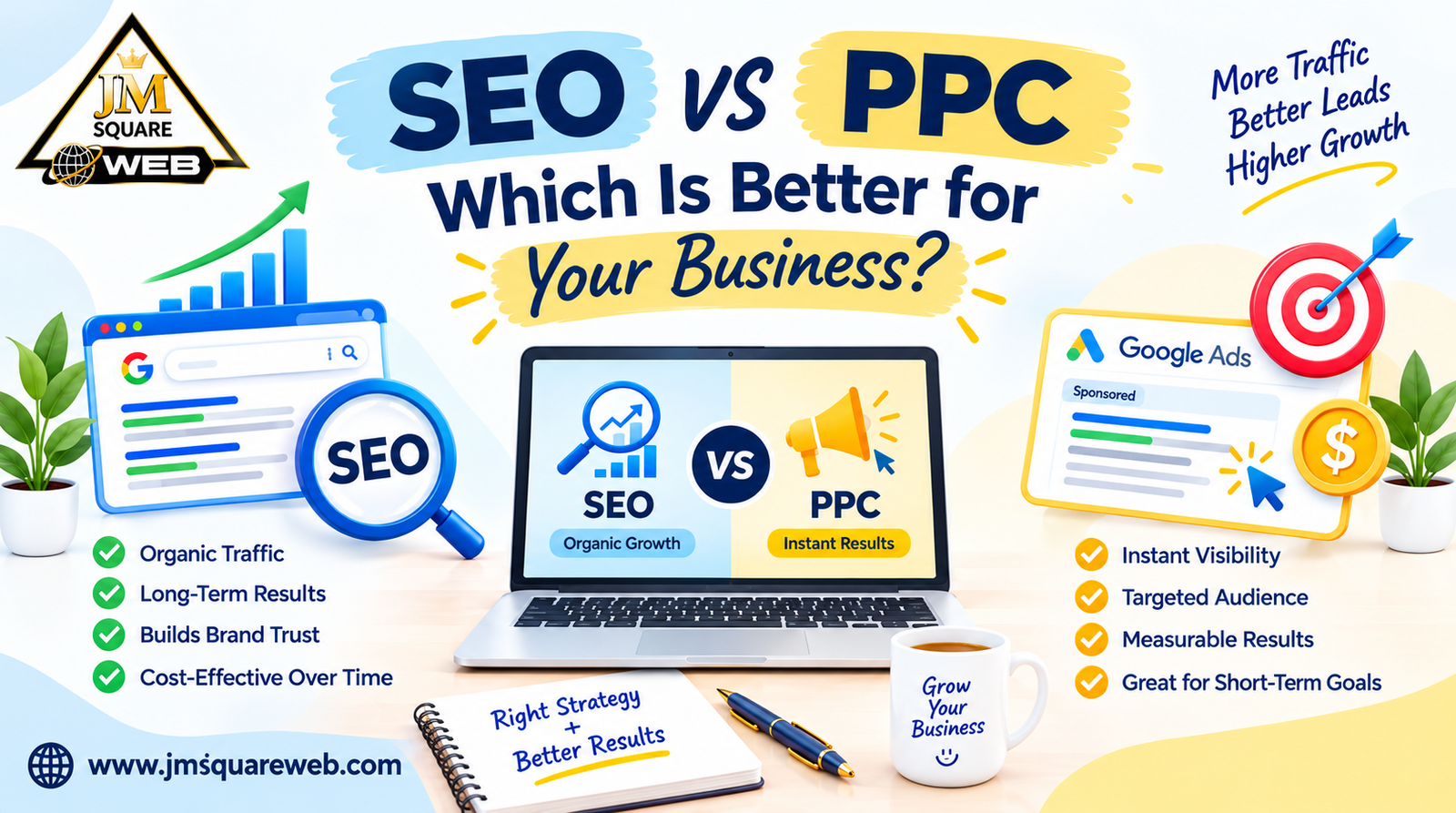
If you’re trying to figure out where your marketing budget should go, you’ve probably landed on the same two options everyone else does: search engine optimisation or pay-per-click advertising. It’s one of the most common questions business owners ask, and honestly, there isn’t a single right answer for everyone. The answer depends on your timeline, your budget, and what you’re actually trying to achieve.
This article breaks down SEO and PPC in plain terms, compares them where it matters, and looks at how SEO for Small Businesses fits into the bigger picture — especially now that Google’s results include AI Overviews, answer engines, and a search experience that looks pretty different from a few years ago.
What Is SEO?
SEO, or Search Engine Optimisation, is the process of improving your website so it shows up naturally in search results when people look for what you offer. No ad spend, no bidding wars — just a site that Google (and increasingly, AI search tools) trusts enough to recommend.
Good SEO touches a lot of areas: page speed, content quality, mobile usability, internal linking, and local relevance, among other things. It’s not a single fix. It’s more like ongoing maintenance that compounds over time. A blog post you publish today might not rank well for a few months, but once it does, it can keep bringing in visitors for years without you paying per click.
This is exactly why SEO for Small Businesses matters so much. Most small businesses don’t have the budget to outbid national competitors on ads forever, so building organic visibility becomes the more sustainable path.
What Is PPC?
PPC, short for Pay Per Click, is advertising. You choose keywords, set a budget, write an ad, and your business shows up at the top of search results — sometimes within hours of launching a campaign. You only pay when someone actually clicks.
Platforms like Google Ads let you control almost everything: who sees your ad, when they see it, and how much you’re willing to spend per click. That level of control is the main draw. If you need customers this week, not next quarter, PPC is usually the faster route.
The catch is that visibility stops the moment your budget does. Pause the campaign, and your ad disappears from the results. Unlike organic rankings, there’s no lingering effect once the spending stops.
SEO vs PPC: The Core Differences
Here’s where the two approaches really split.
Speed. PPC wins outright. Ads can go live and start generating clicks almost immediately. SEO takes weeks or months to show meaningful movement, depending on competition and how established your site already is.
Cost over time. SEO tends to be cheaper per visitor once it’s up and running, because you’re not paying for every click. PPC costs scale with competition — some industries pay well over $20 per click for competitive terms, and that adds up fast if you’re running campaigns month after month.
Longevity. This is probably the biggest difference. SEO builds an asset. A well-ranking page keeps working for you long after it’s published. PPC is rented space — the second you stop paying, the traffic stops too.
Trust. Plenty of research over the years has shown that users trust organic results more than ads. People have got good at spotting the “Sponsored” label and skipping past it, especially younger audiences who grew up scrolling past ads without a second thought.
Targeting precision. PPC has the edge here. You can target by location, device, time of day, even specific audience segments, with a level of control that organic SEO simply can’t match.
None of this means one approach is objectively better. It means they solve different problems.
Why SEO for Small Businesses Still Matters in the AI Search Era
Search has changed a lot recently, and it’s worth addressing that directly. Google now shows AI Overviews for a large share of searches, and tools like ChatGPT and Perplexity have become part of how people research before buying something. Terms like AEO (Answer Engine Optimisation) and GEO (Generative Engine Optimisation) have started showing up in marketing conversations alongside traditional SEO.
Here’s the part that gets lost in all the new terminology: these AI systems still pull from the same signals that have always mattered — clear, well-structured content, credible sources, and sites that Google already trusts. A business with weak SEO fundamentals doesn’t suddenly get picked up by AI Overviews just because it exists. If anything, SEO for Small Businesses matters more now, because AI-driven search has made it even more important to be the source that gets cited, not just the page that ranks tenth on page one.
So while the acronyms multiply, the underlying strategy hasn’t really changed. Strong SEO is still the foundation everything else builds on.
When PPC Makes More Sense
There are real situations where PPC is the smarter first move:
- You’re launching a new product or business and need visibility right away, not in six months.
- You’re testing which messaging, offers, or keywords actually convert before investing in long-term content.
- You operate in a market where organic competition is brutal and ranking naturally could take a year or more.
- You have a seasonal push — a sale, an event, a limited-time offer — where speed matters more than sustainability.
PPC also works well as a bridge. It can generate revenue while your SEO efforts are still building momentum in the background, which is a strategy a lot of growing businesses use without even realising it has a name.
When SEO Makes More Sense
SEO tends to be the better long-term investment when:
- Your customers research before they buy, which is common in service industries, healthcare, and B2B.
- You want a marketing channel that doesn’t disappear the moment your budget gets tight.
- Cost per click in your industry is high enough that paid ads eat into your margins fast.
- You’re building a brand you plan to run for years, not just a short-term campaign.
If any of that sounds like your business, investing in SEO for Small Businesses is probably going to pay off more than pouring everything into ads.
The Smarter Answer: Use Both
Most experienced marketers will tell you the same thing — treating SEO and PPC as competing choices misses the point. They work well together, and a lot of successful small businesses run both at the same time, just with different weight depending on where they are.
A common approach looks something like this: lean more heavily on PPC early on, while your SEO content is still gaining traction, then gradually shift budget toward SEO as your organic rankings mature and start pulling their own weight. By the time your site is ranking well for the keywords that matter, you can scale back paid spend and let organic traffic carry more of the load.
This is also where SEO Services and PPC Services tend to overlap in practice. A page built for SEO can inform what keywords perform well in ads, and PPC data can reveal which search terms are worth targeting organically. Used together, they make each other stronger.
Where an SEO Agency Fits In
Managing SEO and PPC at the same time takes more hours than most business owners have to spare, which is usually when working with an SEO Agency starts to make sense. A good agency isn’t just chasing rankings or ad clicks for the sake of a report. It looks at what’s actually bringing in paying customers and adjusts the strategy based on real results, not vanity metrics.
The right agency should also be able to explain, in plain language, why they’re recommending one channel over another for your specific situation — not just hand you a dashboard full of numbers with no context behind it.
Don’t Forget Social Media Marketing
SEO and PPC usually get the spotlight, but Social Media Marketing plays a supporting role that’s easy to underestimate. It doesn’t directly boost your search rankings, but it drives traffic, builds brand recognition, and increases the chances that people search for your business by name later on — which search engines tend to read as a strong trust signal.
A blog post that only lives on your website has limited reach. The same post shared across social channels reaches people who might never have searched for your business directly, and some of them come back later ready to buy.
Final Thoughts
There’s no universal winner in the SEO vs PPC debate. PPC gets you visibility fast. SEO builds something that lasts. The businesses that grow steadily tend to be the ones that stop treating this as an either-or decision and instead build a strategy where both channels support each other.
If you’re still not sure where to start, the safest bet is usually this: use PPC to generate results while you’re waiting, and invest in SEO for Small Businesses as the long-term engine that keeps working long after the ad budget runs out.
Get in Touch
Not sure whether SEO, PPC, or a mix of both fits your business right now? The team at JM Square Web can walk you through a strategy built around your budget, timeline, and goals — covering everything from SEO Services and PPC Services to Social Media Marketing. Reach out through jmsquareweb.com to get started.
Frequently Asked Questions
What is SEO for small businesses, in simple terms?
It’s the process of making your website easier for Google, and increasingly AI search tools, to find and trust. For a small business, that usually means clear service pages, decent page speed, and content that actually answers what customers are searching for, rather than anything technical or complicated.
How long does SEO take to show results?
Most small businesses start seeing movement within three to six months, with stronger results building over the following year. It’s slower than paid ads, but the visibility tends to stick around long after you stop actively working on it, which is the trade-off worth understanding upfront.
Do I need an SEO agency, or can I manage it myself?
Plenty of business owners handle the basics themselves early on. The trouble usually starts once the business grows and there’s no time left to keep up with algorithm changes or content updates. That’s typically when bringing in an SEO agency starts to make financial sense.
Does Search Engine Optimisation still matter with AI Overviews in search results?
Yes, if anything it matters more. AI tools pull answers from sites that already have strong SEO fundamentals in place. A page with weak structure or thin content won’t get picked up by an AI summary just because it exists, so the groundwork hasn’t changed even though the results page looks different.
How does social media marketing fit alongside SEO?
They’re not the same thing, but they support each other. Social media marketing won’t move your Google rankings directly, but it drives traffic and brand awareness, which often leads to more people searching for your business by name later on, something search engines read as a trust signal.
What SEO services should a small business start with first?
Start with the fundamentals: title tags, page speed, a claimed and optimised Google Business Profile, and a handful of well-written service pages. Most SEO services build outward from there once those basics are solid, rather than jumping straight into advanced tactics.