If you run a small business, you’ve probably heard that SEO for small businesses looks nothing like it did five years ago. That’s true, but not in the scary way most headlines make it sound. Google hasn’t stopped ranking websites. It’s just got better at understanding them, and it now shares space with AI tools that answer questions directly instead of just linking out to them.
This guide walks through what actually matters for SEO for small businesses in 2026 — from the basics of search engine optimisation to newer ideas like AI Overviews and answer engines. It’s written for business owners, not tech teams, so expect plain language over jargon.
What Does SEO for Small Businesses Actually Mean in 2026?
At its core, SEO for small businesses is still about the same thing it’s always been: helping people find your website when they search for what you offer. What’s changed is where that search happens and how results get shown.
A few years ago, ranking on page one of Google was the whole game. Now, a chunk of searches never even reach a results page — they get answered right inside an AI Overview, a chatbot response, or a voice assistant reply. So SEO for small businesses in 2026 means optimising for two audiences at once: the person searching, and the AI systems summarising answers on their behalf.
This doesn’t mean starting from scratch. It means building on solid fundamentals and adding a layer of clarity that AI tools can pick up on.
Why SEO for Small Businesses Matters More Than Ever
Big brands can afford paid ads to stay visible. Most small businesses can’t run that budget every month, which is exactly why organic search still carries so much weight for them. Good SEO for small businesses lowers the cost of getting found — once a page ranks well, it keeps bringing in visitors without a daily ad spend.
There’s also a trust factor. People tend to click on businesses that show up naturally in search results before they click on an ad. A well-optimised website with clear service pages, local information, and helpful content builds that trust faster than a paid listing ever could.
SEO vs AEO vs GEO vs AIO: What Small Business Owners Should Know
You’ll see these acronyms thrown around a lot this year, so here’s the short version.
- SEO (Search Engine Optimisation)— the foundation. Optimising your site’s content, structure, and technical health so search engines can crawl, understand, and rank it.
- AEO (Answer Engine Optimisation)— writing content in a way that directly answers a question, so AI tools like Google’s AI Overviews or ChatGPT can pull your answer into their response.
- GEO (Generative Engine Optimisation)— making sure your business shows up when someone uses a generative AI tool to research or compare options, not just when they type a query into Google.
- AIO (AI Optimisation)— using AI tools yourself to speed up keyword research, content planning, and site audits, so your SEO for small businesses strategy moves faster.
Here’s the part that matters most: none of these replace traditional SEO. They sit on top of it. A site with weak SEO fundamentals won’t show up in AI answers either, because those systems still rely on the same signals — clear content, authority, and trust — that Google has rewarded for years.
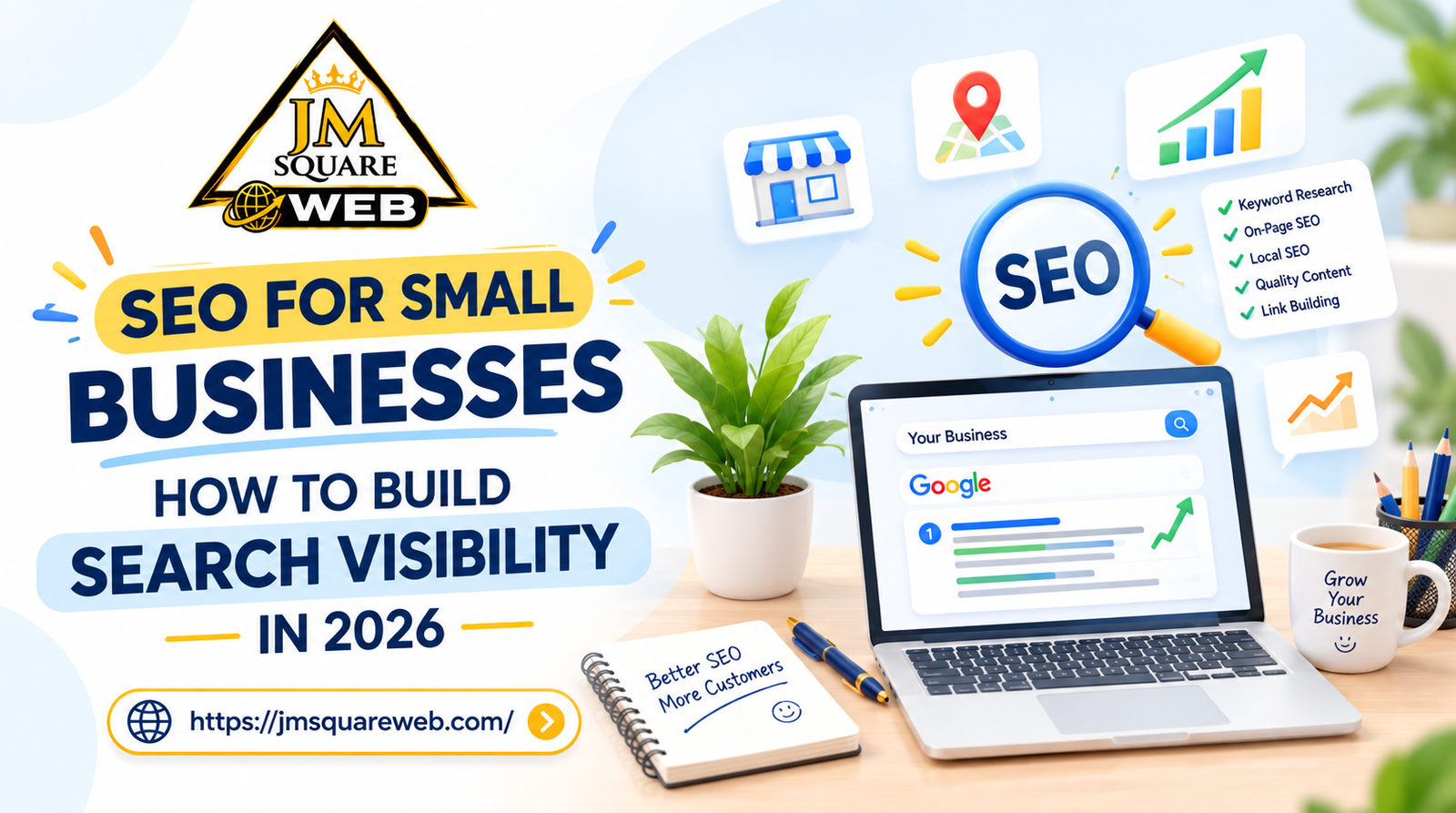
On-Page SEO Fundamentals Every Small Business Should Get Right
This is where most small business websites lose visibility, often without realising it. A few basics go a long way:
- Title tags and meta descriptions— every page needs a unique, descriptive title that includes the main keyword naturally, not stuffed in.
- Heading structure— one H1 per page, followed by logical H2 and H3 subheadings, makes content easier for both readers and search engines to scan.
- Page speed and mobile experience— a slow or clunky mobile site pushes people away before they even read your content.
- Internal linking— connecting related pages helps visitors (and search engines) understand how your site is organised.
- Image alt text— describing images properly helps with accessibility and gives search engines more context about your page.
None of this is complicated on its own. The challenge is doing it consistently across every page, which is usually where business owners run out of time.
Local SEO and Google Business Profile: The Fastest Win for Small Businesses
If you serve customers in a specific city or region, local search is probably your quickest path to results. An optimised Google Business Profile, consistent business information across directories, and genuine customer reviews all feed into how you rank for “near me” searches.
A generic page titled “Web Design Services” competes with the entire internet. A page titled “Web Design Services in Santa Clara, CA” competes with a much smaller, far more relevant group of businesses. That’s the difference local optimisation makes, and it’s often the fastest way for a small business to see movement in search results.
Content That Works for Both Google and AI Answer Engines
Here’s something worth understanding clearly: AI tools don’t invent answers out of nowhere. They pull from real content across the web, and they tend to favour content that answers a question directly and early, rather than burying the point three paragraphs down.
A few things help here:
- Answer the main question in the first two or three sentences of a section, then expand with detail.
- Use clear subheadings phrased as questions when it fits naturally (“What is local SEO?” works better than “Understanding Local SEO Concepts”).
- Back up claims with specifics — numbers, examples, or steps — instead of vague statements.
- Keep paragraphs short. Long walls of text are hard for readers and AI crawlers alike to parse.
This kind of writing isn’t really a separate skill from good SEO writing. It’s just SEO writing done without the fluff.
The Role of an SEO Agency in Small Business Growth
Plenty of small business owners try to handle SEO themselves, and for a while, that works fine. The trouble usually starts when the business grows and there’s no time left to keep up with algorithm changes, content updates, or technical fixes.
That’s where working with an SEO agency tends to pay off. A good agency doesn’t just chase rankings for their own sake — it looks at what’s actually bringing in customers and builds a strategy around that. Services like SEO services, technical audits, content planning, and ongoing performance tracking are usually bundled together, which saves a business owner from juggling five different freelancers.
The key is picking an agency that explains what it’s doing and why, rather than one that hands over a monthly report full of numbers with no context.
Social Media Marketing and SEO for Small Businesses: A Combined Strategy
SEO and social media marketing aren’t the same thing, but they support each other more than people assume. Social platforms won’t directly boost your Google rankings, but they do drive traffic, build brand recognition, and give your content more chances to get linked to or mentioned elsewhere online.
A blog post that only lives on your website reaches a limited audience. The same post shared across social channels, with a version adapted for each platform, reaches people who might never have searched for your business directly. Over time, that visibility often turns into the kind of brand searches (“Company Name reviews,” for example) that search engines read as a strong trust signal.
Common SEO Mistakes Small Businesses Make
A few patterns show up again and again on small business websites:
- Writing content for search engines instead of real readers, which usually reads as stiff and gets ignored by both.
- Ignoring page speed and mobile responsiveness until traffic drops noticeably.
- Ignoring Google Business Profile updates, especially hours, photos, and review responses.
- Publishing content once and never updating it, even after it stops ranking well.
- Focusing only on the homepage instead of building out individual service pages that can each rank for specific searches.
Fixing even two or three of these tends to move the needle faster than most business owners expect.
How JM Square Web Helps Small Businesses Build Search Visibility
This is exactly the kind of work JM Square Web focuses on. Rather than treating SEO as a one-time project, the team builds ongoing strategies around technical audits, content that’s genuinely useful to readers, local optimisation, and reporting that’s easy to actually understand.
Whether a business needs help with on-page fixes, a content plan built for both Google and AI answer engines, or support pairing social media marketing with organic search, the approach stays the same: build a strong foundation first, then layer on the newer tactics that 2026’s search landscape demands.
Final Thoughts
SEO for small businesses in 2026 isn’t about chasing every new acronym that shows up in a marketing newsletter. It’s about getting the fundamentals right — fast pages, clear content, honest local information — and then adapting that same foundation for a search landscape that now includes AI-generated answers alongside traditional results.
Businesses that treat AEO, GEO, and AIO as extensions of good SEO, rather than separate projects, tend to come out ahead. The ones chasing shortcuts usually don’t.
Get in Touch
Want help building a search strategy that actually fits your business? Reach out to the JM Square Web team through jmsquareweb.com for a consultation on SEO, local visibility, and social media marketing tailored to your goals.
Frequently Asked Questions
What is SEO for small businesses, in simple terms?
It’s the process of making your website easier for Google, and increasingly AI search tools, to find and trust. For a small business, that usually means clear service pages, decent page speed, and content that actually answers what customers are searching for, rather than anything technical or complicated.
How long does SEO take to show results?
Most small businesses start seeing movement within three to six months, with stronger results building over the following year. It’s slower than paid ads, but the visibility tends to stick around long after you stop actively working on it, which is the trade-off worth understanding upfront.
Do I need an SEO agency, or can I manage it myself?
Plenty of business owners handle the basics themselves early on. The trouble usually starts once the business grows and there’s no time left to keep up with algorithm changes or content updates. That’s typically when bringing in an SEO agency starts to make financial sense.
Does Search Engine Optimisation still matter with AI Overviews in search results?
Yes, if anything it matters more. AI tools pull answers from sites that already have strong SEO fundamentals in place. A page with weak structure or thin content won’t get picked up by an AI summary just because it exists, so the groundwork hasn’t changed even though the results page looks different.
How does social media marketing fit alongside SEO?
They’re not the same thing, but they support each other. Social media marketing won’t move your Google rankings directly, but it drives traffic and brand awareness, which often leads to more people searching for your business by name later on, something search engines read as a trust signal.
What SEO services should a small business start with first?
Start with the fundamentals: title tags, page speed, a claimed and optimised Google Business Profile, and a handful of well-written service pages. Most SEO services build outward from there once those basics are solid, rather than jumping straight into advanced tactics.