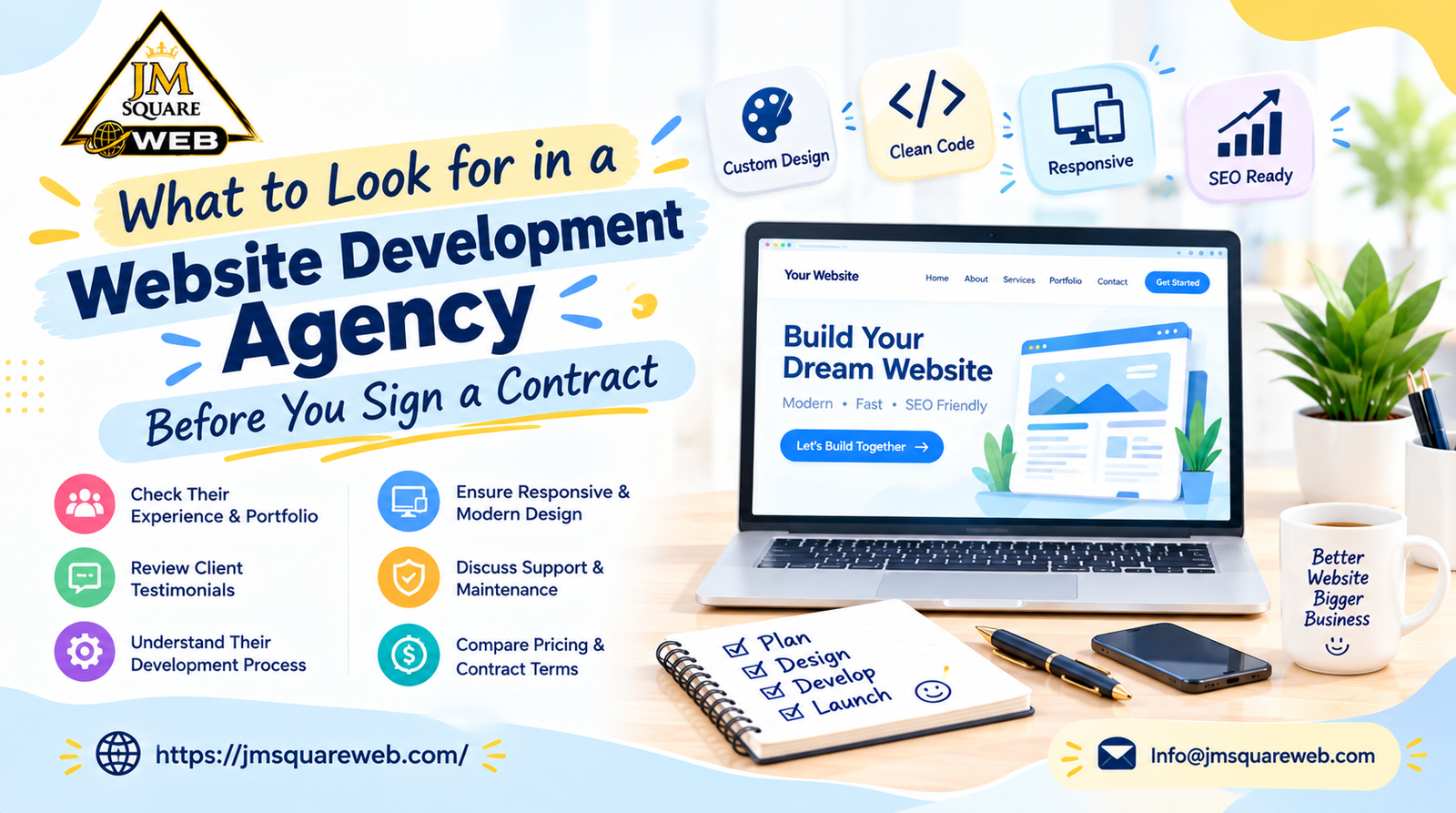
Choosing a website development agency feels like a design decision. It isn’t. It’s a business decision with a contract attached, and the contract is where most of the trouble hides. Sites launch late, cost more than quoted, or go live with no SEO setup. Some owners only find out at the end that the agency controls their hosting and logins.
This guide covers what to check before you sign. It’s written for small business owners, startups and online shop owners who want a website that brings in enquiries, not just one that looks nice.
Quick answer: Before you sign with any website development agency, check for live examples of similar work, SEO built into the build, a clear process, fixed pricing, written ownership of your site, and proper support after launch.
What Does a Website Development Agency Do?
A website development agency plans, designs, builds and launches websites for businesses. A good one also looks after mobile layout, page speed, security, tracking and basic search setup. Many offer ongoing maintenance too.
The best ones treat your website as one part of your wider marketing. A site that nobody can find, or that doesn’t push visitors towards a call or a purchase, is just an expensive brochure.
1. Look at Real Work, Not Just a Portfolio Grid
Screenshots prove very little. Anyone can make a good-looking mock-up.
Open the live websites instead. Load them on your phone. Click through the menu. Fill in a contact form. Notice how long each page takes to appear. Then ask whether the agency has built for businesses like yours. A website development agency that has built for restaurants will understand booking flows. One that has built online shops will understand checkout problems.
Ask for a client you can speak to, or at least a written testimonial from a real person with a real business name. If they can’t offer either, that tells you something.
2. Check That SEO Is Part of the Build
Plenty of sites look great and rank nowhere. The reason is usually simple: nobody planned for Search Engine Optimisation until after launch, when fixing things costs more.
Ask the agency how they handle:
- URL structure and page hierarchy
- Title tags, meta descriptions and heading order
- Image sizes and page speed
- Redirects if you’re replacing an old site
- Schema markup and mobile usability
If the answer is “we can add SEO later”, be careful. A website development agency that works closely with an SEO agency, or offers its own SEO services, will plan these things from day one. That saves you from paying twice.
3. Understand Their Process Before You Pay
A vague process usually leads to a vague result. You should know what happens, in what order, and who you’ll be speaking to.
A solid process looks something like this:
- Discovery:they learn about your business, customers and competitors
- Planning:sitemap, page goals and content plan
- Design:layouts for desktop and mobile that you can approve
- Build and testing:development, forms, speed and security checks
- Launch and support:go-live, tracking setup and a handover
Ask how many revision rounds are included and what happens if you miss a feedback deadline. At JM Square Web, for example, the approach runs through understanding, planning, execution, optimisation and clear reporting. You don’t need that exact list, but you do need something equally clear.
4. Get Pricing in Writing and Ask What Isn’t Included
Low quotes can be expensive. The cheap price often leaves out things you’ll need later.
Ask directly whether the quote covers:
- Domain name and hosting
- SSL certificate
- Premium plugins or themes
- Stock photos and copywriting
- Training on how to edit your own site
- Monthly maintenance and security updates
Fixed-price projects are easier to budget for. Hourly billing can work, but only with a cap. Whichever model they use, get a written scope. If you ask for an extra page later, you should already know what it costs.
5. Read the Contract Like It Matters
It does. This is the part most people skim, and it’s the part that causes disputes.
Look for these points:
- Ownership:You should own the design, content and code once you’ve paid
- Domain and hosting:The domain should be registered in your name, and you should have admin access
- Payment schedule:Milestone payments are safer than paying everything upfront
- Deadlines:Dates for each stage, and what happens if they slip
- Revisions:How many rounds you get
- Bug fixes:A free fix period after launch, usually a few weeks
- Exit terms:How you leave and get your files if things go wrong
For large projects, it’s worth having a solicitor read the contract. A small fee now can save a big argument later.
6. Test Their Thinking on Speed, Mobile and Security
Most people now browse on phones, and Google judges pages largely on how they perform for real users. Slow loading, jumpy layouts and awkward tap targets hurt both rankings and sales.
Ask how the website development agency tests for Core Web Vitals, mobile layouts and accessibility. Ask how they handle backups, updates and security. You’re not looking for technical jargon. You’re looking for a plain, confident answer.
7. Ask Whether They Build for AI Search and Answer Engines
Search has changed. People now get answers from Google’s AI Overviews and chat-based tools, not only from the usual list of links. These systems tend to pull from pages that are clearly written and well organised.
In practice, that means:
- One clear topic per page
- Headings that match real questions
- Short direct answers near the top
- FAQ sections marked up with schema
- Consistent business details: name, address and phone number everywhere
A modern website development agency should be comfortable talking about this. If they only mention colours and fonts, they may be behind.
8. Check What Happens After Launch
Launch day isn’t the end. Plugins need updating. Forms break. You’ll want new pages. Search results change.
Ask who you contact when something goes wrong, how fast they reply, and whether support is included or billed separately. A dedicated contact beats a ticket system where you explain your site from scratch each time. Also ask for reporting that a normal person can read, not a spreadsheet full of numbers with no explanation.
9. See Whether They Can Support Your Wider Marketing
Your website works best alongside other channels. A digital marketing agency can connect your site to search, ads and social, so each part helps the others.
For example, PPC services need landing pages that load fast and convert. Pay per click campaigns waste money if the page behind the ad is confusing. Social media marketing sends people to your site, so the site needs to make a good first impression.
That’s why many businesses prefer a marketing company that handles several of these under one roof. A marketing agency with digital marketing services across SEO, PPC, social, email and web development can keep your messaging consistent. It also means one team understands the whole picture.
Red Flags to Walk Away From
Some warning signs show up early:
- No live examples of past work
- Pressure to sign on the first call
- A contract that doesn’t mention ownership
- Refusing to share hosting or admin access
- Promising number-one rankings, which nobody can honestly guarantee
- Vague answers when you ask about SEO, speed or support
If two or three of these appear, keep looking.
Why Businesses Choose JM Square Web
JM Square Web is a UK-based Swindon agency that helps startups, local businesses, e-commerce brands, professional services and restaurants grow online. The team has more than eight years of combined experience, and each client gets a dedicated account manager, so you aren’t passed between departments.
Their website development work focuses on responsive, easy-to-use sites built for SEO, paid ads and long-term growth. Reporting is kept simple, and strategies are built around your goals rather than a fixed package. They also offer a free website audit if you want an honest look at your current site before deciding anything.
Contact JM Square Web
Want to talk through your project? Get in touch with JM Square Web for a quick, no-pressure conversation.
- Phone:07508 330007
- Email:Info@jmsquareweb.com
- Address: May Close, Swindon, SN2 1XA, United Kingdom
- Website:https://jmsquareweb.com/
Frequently Asked Questions
How do I choose a website development agency?
Check live examples of similar work, ask about their process, and compare written quotes. Make sure SEO is included in the build and that the contract says you own the site. Speak to at least one past client if you can.
How much does a website development agency charge?
It depends on size and features. A simple brochure site costs far less than an online shop with payments and custom features. Ask for a fixed quote that lists exactly what’s included, plus any yearly costs like hosting and maintenance.
How long does it take a website development agency to build a site?
Small business sites often take a few weeks, while larger or custom projects take longer. Delays usually come from late content or slow feedback, so agree timelines in the contract and send your materials early.
Should my website development agency also handle SEO?
It helps a lot. When SEO is planned during the build, you avoid expensive fixes later. If your agency doesn’t offer SEO services, ask which SEO agency they work with, and how they hand over the work.
Who owns the website after it’s built?
You should, once you’ve paid in full. Check the contract for ownership of the design, content and code, and make sure the domain is registered in your name.
Can one marketing agency handle my website, PPC and social media?
Yes. Many businesses prefer this because the messaging stays consistent and one team understands your goals. JM Square Web offers SEO, PPC, social media, email, e-commerce marketing and website development together.
Final Thoughts
The right website development agency will explain things in plain English, show real results, put ownership in writing and stay around after launch. The wrong one will rush you to sign. Take your time, ask the awkward questions, and read the contract before you commit.
If you’d like a second opinion on your current site or a quote for a new one, contact JM Square Web on 07508 330007 or at Info@jmsquareweb.com.